DriveAnchor: Progressive Anchor-based Flow Learning for Autonomous Driving Planning

Limin Yan1*† Haoyun Tang1,2* Yutao Qiu1,3 Hongqing Liu1 Zhandong Mei2 Haoyu Xu1§
1Meituan 2Xi'an Jiaotong University 3Beijing Institute of Technology
*Equal contribution  ·  †Lead corresponding author  ·  §Co-corresponding author

DriveAnchor generates route- and maneuver-compliant trajectories from a shared anchor vocabulary and runs on a real vehicle in urban traffic.

Abstract

Autonomous-driving planners must generate route- and maneuver-compliant trajectories under a limited decoder-call budget while adapting offline to black-box static-collision feedback. We propose DriveAnchor, a three-stage framework built around a shared vocabulary of recorded trajectories and a continuous trajectory interface. The vocabulary supports flow-matching (FM) residual learning, Energy Field (EF) corridor-conditioned initialization, and anchor-guided zeroth-order reward fine-tuning. The reward update operates in trajectory space without policy likelihoods or reward gradients, enabling offline adaptation of a deterministic decoder.

On sampled subsets of nuPlan Val14 and Test14-hard per simulation mode, DriveAnchor achieves the highest reactive scores among the compared methods: 81.50 and 65.74, respectively. We further integrate the trajectory generator into a real vehicle's planning pipeline and demonstrate its operation on urban roads. On 10,000 held-out internal scenarios, under the original non-EF prior and a fixed two-call FM budget, reward fine-tuning reduces short- and long-horizon static candidate collision rates from 27.22% and 56.54% to 2.94% and 7.15%, respectively, and improves 8-s best-of-set minADE from 2.27 to 1.34 m. In a separate junction diagnostic on checkpoints before Stage 3, one and two EF calls raise corridor-guidance satisfaction from 22.10% to 74.13% and 87.92%, respectively. Additional ablations support the benefits of real-trajectory priors and anchor-guided exploration. In real-vehicle tests, trajectory generation takes 2.06 ms on average.


Method

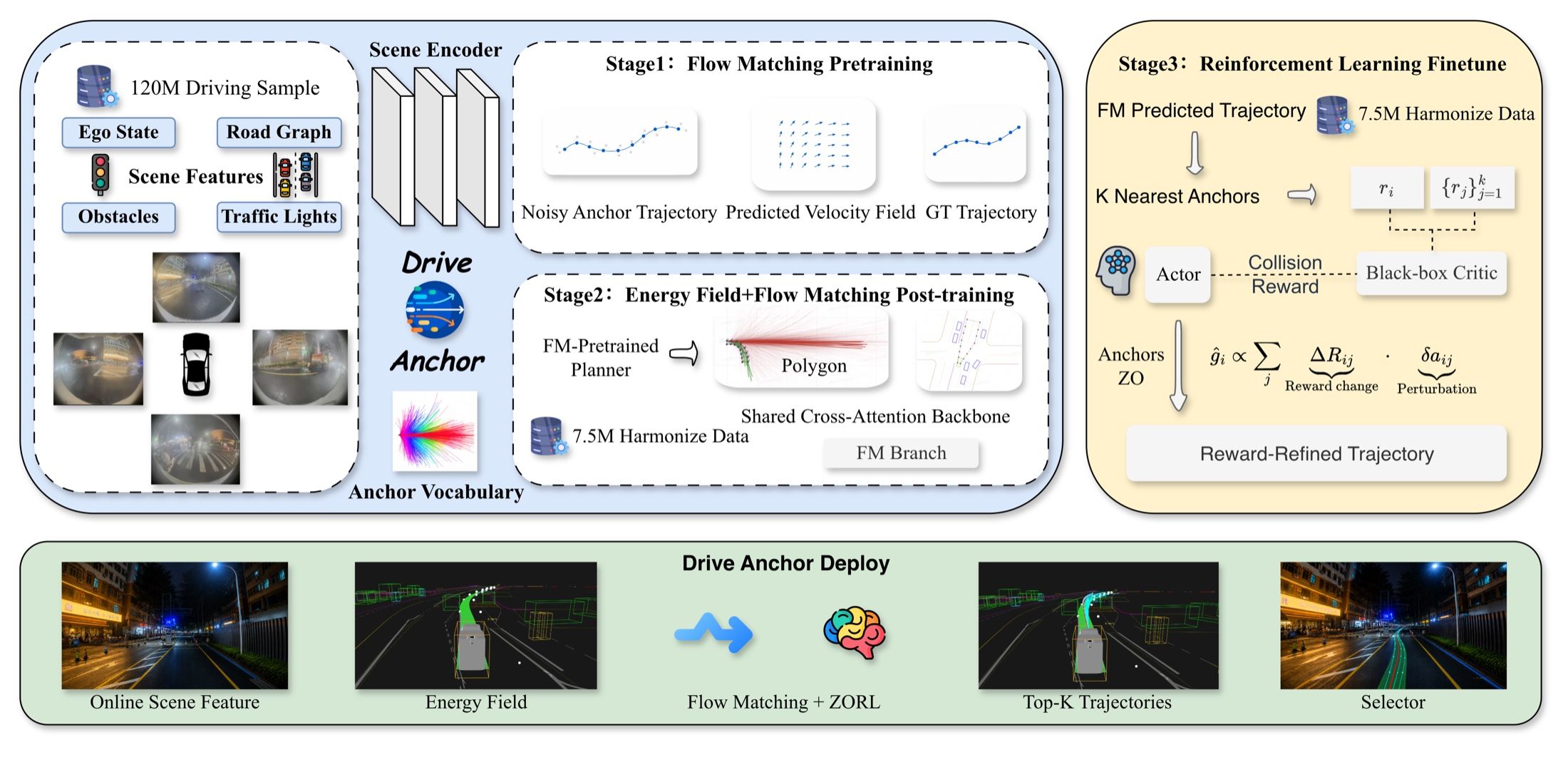
DriveAnchor training and deployment pipeline: anchor vocabulary, three training stages, and on-vehicle deployment

Figure 1: Overview of DriveAnchor. A shared trajectory vocabulary connects FM residual learning, EF request control, and offline anchor-guided zeroth-order reward adaptation. At deployment the scene is encoded once, EF adjusts the initialization, and FM refines it for the downstream selector.

Shared trajectory vocabulary

Recorded trajectories provide structured starting points for supervised correction and output-space exploration, preserving multimodality when the deterministic decoder produces similar candidates.

Progressive training

Stage 1 learns FM residuals from local anchor–ground-truth pairs. Stage 2 learns corridor-conditioned EF initialization jointly with FM. Stage 3 adapts FM with black-box reward feedback while retaining regression.

Likelihood-free adaptation

Vocabulary neighbors define exploration directions. Reward differences provide a zeroth-order signal in trajectory space, without policy likelihoods or reward gradients.

Experiment Results

nuPlan closed-loop evaluation

Official closed-loop score from 0 to 100, higher is better. Val14 and Test14-hard each use a fixed sampled subset of scenarios per simulation mode, and every re-evaluated method uses the same list. DriveAnchor achieves the highest reactive (R) scores on both benchmarks. Under non-reactive (NR) replay it is close to PlanTF on Val14 and below PlanTF and PLUTO on Test14-hard.

MethodVal14 NR ↑Val14 R ↑Test14-hard NR ↑Test14-hard R ↑
PLUTO w/o refine.*88.8978.1170.0359.74
PlanTF84.7276.9569.7061.61
UrbanDriver68.5764.1150.4049.95
STR2-CPKS-800M w/o refine.*65.16—52.57—
PDM-Open*53.5354.2433.5135.83
Diffusion-ES w/o LLM50.00———
GameFormer w/o refine.13.328.697.086.69
DriveAnchor (ours)84.8081.5063.3765.74

Table 1: nuPlan official closed-loop scores. NR: non-reactive logged-traffic replay. R: reactive simulation with IDM-driven surrounding vehicles. A dash means not reported or not evaluated. An asterisk marks configurations whose input includes a pre-searched reference line or additional proposals.

Main results on 10,000 held-out scenarios

Candidate metrics are measured before downstream selection. Errors and collision rates are lower-is-better; reward is higher-is-better. At a fixed two-call FM budget, reward fine-tuning lowers short- and long-horizon collision rates and improves minADE@80 under the original prior. EF changes the initialization and adds inference calls.

MetricFM×2FMRL×2EF×1 + FM×1EF×1 + FMRL×1EF×1 + FMRL×2
Trajectory accuracy (m)
minADE@30 ↓0.350.250.560.280.22
minFDE@30 ↓0.800.541.270.550.44
minADE@80 ↓2.271.342.351.250.95
minFDE@80 ↓4.422.824.442.651.87
Candidate static collision
Short-horizon collision ↓0.27220.02940.13130.04230.0188
Long-horizon collision ↓0.56540.07150.26270.11780.0873
Reward
Mean reward ↑59.2278.4670.1377.1478.87

Table 2: Main internal results. Collision values are fractions of candidates. Bold marks the best value within each prior group: the original prior (first two columns) and the EF prior (last three).

Qualitative results

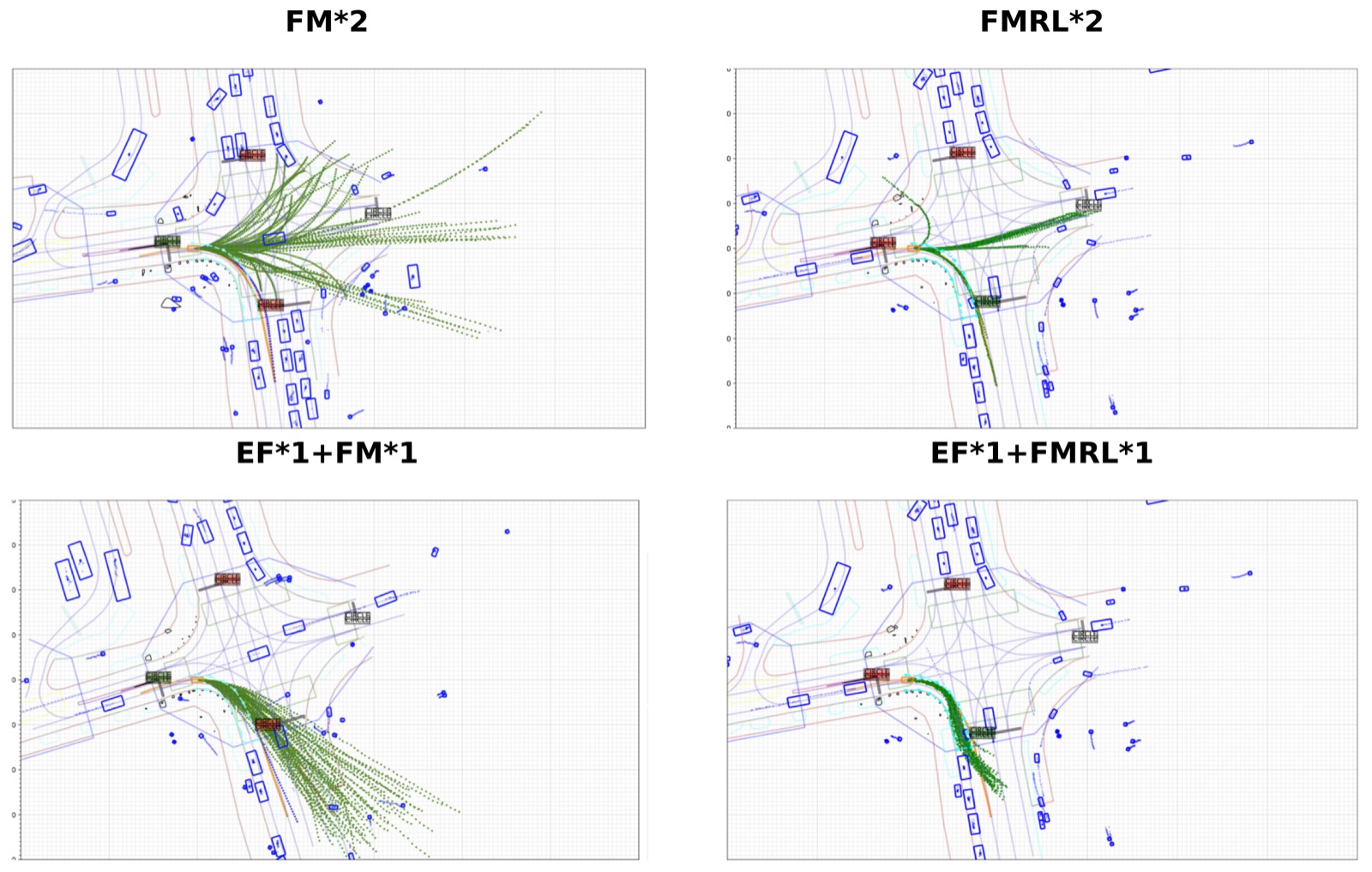
Residual-screened top-50 candidate trajectories at one junction under four configurations

Figure 2: Residual-screened top-50 candidates before the downstream selector under four configurations at the same junction. These illustrate the candidate subset, not final closed-loop outcomes.

Real-vehicle Deployment

Anonymized clips from the on-road deployment recording. Each clip shows the front camera above the planner's bird's-eye view. Playback speed can be changed from the control bar inside each clip. The full 41-minute drive is at the bottom.

Lane change

Short-window lane change

Multi-lane change

Pedestrian crossing

Non-motorized road-user crossing

Parallel left turn

U-turn

Construction zone I

Construction zone II

🌟 41-minute urban drive

This recording covers one on-road test session in urban traffic. DriveAnchor generated the executed trajectories continuously for the whole 41-minute route, and the safety driver did not take over at any point.

The route covers a wide range of scenarios: intersections, merging and weaving areas, and lane changes, including short-window lane changes and consecutive multi-lane changes. Along the way the vehicle negotiates with surrounding motor vehicles and yields to crossing pedestrians and non-motorized road users. The eight clips above are excerpts from this recording.

  • Duration 41 min 39 s
  • Manual takeovers 0
  • View anonymized front camera (top) and the planner's bird's-eye view with the selected trajectory (bottom)

Full 41-minute deployment drive